
A Guide On How to Transfer Money Internationally
28 Apr 2026
In today’s globalised world, it’s common to travel abroad or relocate in the pursuit of better academics or job opportunities.
Whether it’s sending money back home to families, paying tuition fees to foreign universities, or purchasing tickets and tour packages have become increasingly common reasons to send money internationally.
While cross-border money transfers are readily available via the international financial systems, it’s important to consider speed, security, and fees. If you’re not careful, you might find yourself facing high fees, long wait times, or both.
Wondering how to send money overseas quickly, cheaply and securely? You’ve come to the right place. This guide covers all you need to know about sending money overseas so you can choose the best option for you.
Best ways to transfer money overseas
International bank transfers - best for large sums
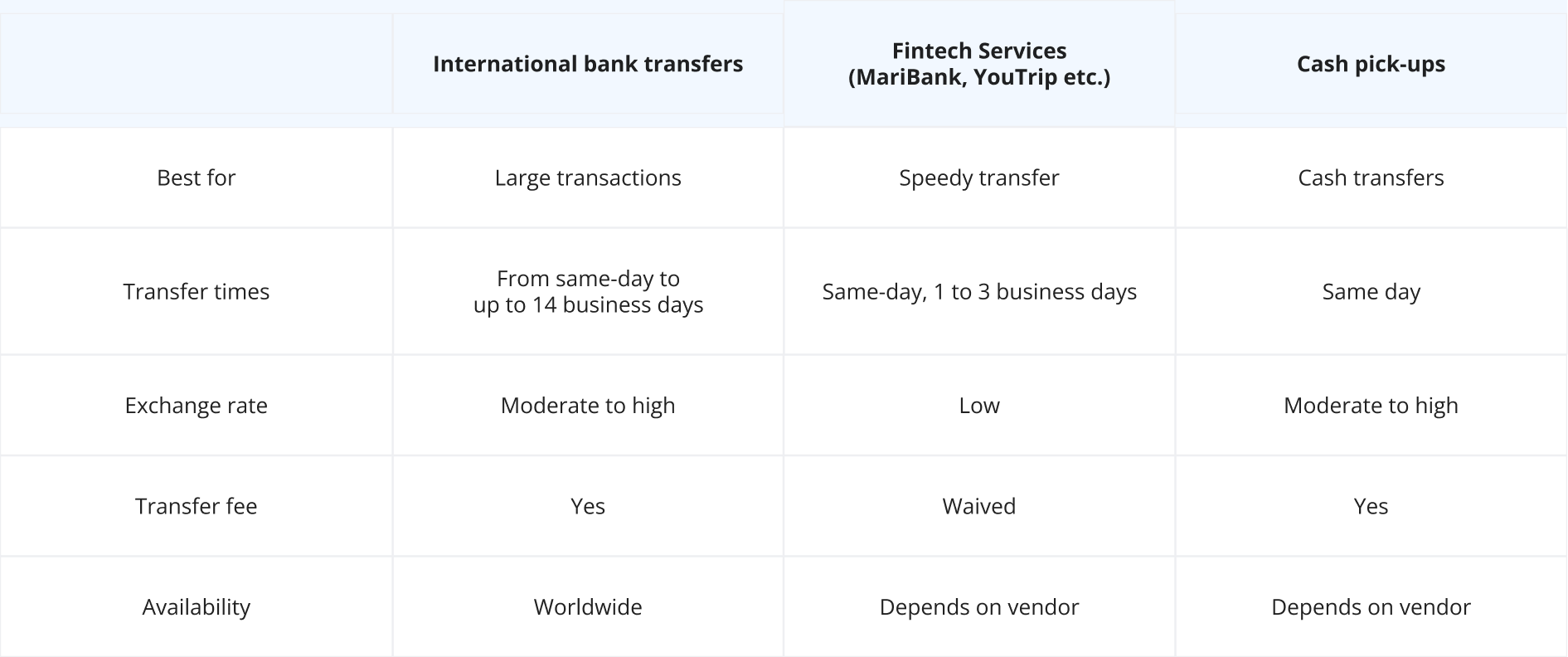
International bank transfers are conducted via SWIFT, a global standard that facilitates moving money across borders securely. Thanks to this, banks are able to send your money to any country worldwide (as long as the destination is not under sanctions).
However, international bank transfers commonly come with bank fees – either a fixed amount or a percentage of the amount transferred, depending on the bank. Also, your transfer is pegged at a foreign exchange rate at the sole discretion of the bank. This means that international bank transfers may not be the most cost-effective option when sending money internationally.
For these reasons, international bank transfers are better reserved for when you need to transfer large sums.
That said, incumbent service offered by digital banks such as MariBank’s Overseas Transfers, actually offers $0 transfer fees* currently and you can transact at any amount without worrying about such fees!
Check out the promotion here:
MariBank Overseas Transfers Promotion

Fintech Services - Best for speed and affordability
You might have come across fintech services such as YouTrip, Wise, etc. just to name a few.
They are able to provide better foreign exchange rates via bulk purchase agreements – resulting in more affordable overseas money transfers for you. Such fintech platforms tap on partner networks to send money securely across a wide range of popular overseas destinations, so it’s highly likely you’ll be able to make the international money transfer you need.
Unlike these transfers services, MariBank operates as a digital bank which offers banking services and also Overseas Transfers, which is a feature that can compete in speed and affordability, making it a suitable choice for those who value time and efficiency to make money transfers via its mobile app.
Cash pick-up - Best for cash transfers
There may be times when your recipient needs cash but they might not have access to a bank account where they are.
In such situations, the best option would be to use a cash pick-up service. You can make your international money transfer digitally, but your recipient will need to pick up the transfer in cash at a representative office over at the destination country. They will need to bring along official documentation for identification purposes.
Depending on the destination, cash pick-up services can come with high fees, and there may also be limited availability or locations for your recipient to pick up the transfer, so it’s best to research your options.
What to look for when transferring money overseas?
Exchange rate
The biggest cost driver when transferring money overseas is the exchange rate applied to your transfer. This is determined by the bank or service provider, and directly impacts the cost of sending money overseas.
The exchange rate is usually calculated by taking the interbank rate or mid-market rate (the wholesale, real-time rate that large banks and financial institutions use to trade currencies or borrow money from each other) and adding a markup known as a spread. The higher the spread, the worse your exchange rate – and higher the cost of your international money transfer.
Transfer fee
Cross-border money transfers traditionally come with a transfer fee attached, which is taken to cover associated fees or charges that may be incurred. For instance, banks commonly charge transfer fees to cover membership and messaging fees for using SWIFT.
If one is charged, transfer fees may be pegged as a fixed amount, or a percentage of the amount transferred. When transferring larger sums, choosing a service with a fixed transfer fee may be more cost-effective.
Even better, pick an option that waives the transfer fee – this is a great way to save when sending money overseas.
Speed of transfer
The time taken for your international money transfer to be completed will vary according to which channel you choose (bank transfer, fintech service, cash pick-up), the currency, and the destination of your recipient.
Overseas money transfers may take anywhere from same-day to several business days, so it’s best to find out beforehand.
Supported countries and currencies
Another factor to consider is what currencies you can send, and to where. This is because different service providers offer different transfer destinations, and you won’t be able to make a money transfer if your recipient is in a country or jurisdiction that is not supported.
As a general rule, most banks offer the widest range of countries and currencies. But if you’re looking to send money to a popular country, you’ll likely be able to do so on many fintech platforms and cash pick-up services too.
Transparency of total cost
Last but not least, consider transparency – i.e., how easy is it for you to understand the total cost of your international money transfer.
The cost of your transfer (including fees and charges) should be apparent at a glance. If you’re finding it difficult to understand how much you’re paying for the transfer, you may end up paying more than expected.

Steps to transfer money internationally
Here’s a general step-by-step guide to making an international money transfer. Please note there may be differences based on the actual service you choose.
- Pick your service provider. Are you choosing an international bank transfer, a fintech digital platform, or a cash pick-up service?
- Enter the details of your recipient. You’ll typically need to provide personal details such as full name, address, and bank account details.
- Select currency and amount. Make sure the currency you want to send is available. If not, the currency is not supported.
- Review exchange rate and fees. Check the exchange rate, transfer fee and any other charges that may be present. Ensure you understand the total cost clearly.
- Confirm transfer. If all is well, submit or confirm the transfer to initiate the transaction.
- Track your transfer. You should be able to track your money transfer on your mobile banking app. When your transfer has been completed, you should receive a notification.
How long does it take to transfer money overseas?
The amount of time it takes to transfer money overseas depends on the service chosen, currency, and destination. Here’s how long each method typically takes, although exceptions may apply.
International bank transfer
Some banks may offer same-day fund transfers to selected countries, Otherwise, bank transfers typically take between 1 to 3 business days to complete. However, the currency may also impact the time taken, with some bank transfers taking up to two weeks to complete.
Digital fintech platforms
Similarly, fintech platforms may offer instant transfers to certain countries – this depends on their partner network. Otherwise, most money transfers take 1 to 3 business days to complete.
Cash pick-ups
More established cash pick-up service providers are able to offer instant pick-ups within minutes of the transfer going through.
However, this depends on how quickly the funds are transmitted. Issues with identity verification (such as not bringing the correct documents) may also result in delays.
MariBank Overseas Transfers - Safe, speedy and affordable
The MariBank Overseas Transfers can be used using the Mari Savings Account. Here’s what you can look forward to!
- Competitive fees and savings: Enjoy Enjoy $0 Transfers Fee* Save more on every transfer with preferential FX rates. See your FX rate and transfer cost before you transfer.
- Seamless transfers: Make your overseas transfer right from your Mari Savings Account, no need for external top-ups or additional transactions.
- Over 59 countries and 21 currencies from May 2026
- Speedy transfers: Enjoy instant money transfers to China, India, Canada, United Kingdom, and Thailand. Transfers take 1 to 3 days in all other destinations.
- Tracking: Easily track your money transfer right on the MariBank app. Be instantly notified when your transfer clears.
Try MariBank Overseas Transfers
Disclaimer
* $0 Transfer Fee is a promotional waiver till 31 December 2026 and is subject to the Overseas Transfers Unlimited $0 Transfers Promotion Terms & Conditions. For full terms and conditions, please see here.
Read More