

Best Business Bank Accounts in Singapore. What to Compare
31 August 2026
A dedicated business bank account is an important tool for anyone running a business. Its main use is to keep personal and business transactions separate, allowing business owners a clear look at income and expenses in one place - without having to sort through grocery bills, credit card payments and other irrelevant transactions. With a business bank account, everything from bookkeeping to employee claims and vendor payments become much clearer and easier.
Much like personal bank accounts, business bank accounts aren’t one-size-fits-all. A freelancer receiving local payments may prefer a basic, no-fee bank account, while a store owner dealing in imported goods could require multi-currency capabilities. In short, it depends on what type of banking transactions your business needs to make.
In this guide, we will look at the common features of business bank accounts, and how you can choose the best one for your needs.
What is a business bank account?

A business bank account is a bank account that caters to the banking needs of a business entity. It is opened under a registered business, using the company’s name and Unique Entity Number (UEN, a 9 or 10 digit identification number issued to companies and organisations in Singapore).
While personal bank accounts cater to personal banking needs, business bank accounts are designed for companies to receive, transfer and pay money. To better support business activities, business bank accounts may offer additional features and benefits, such as multiple authorised users, chequing facilities, credit lines or credit cards, and the ability to handle multiple currencies apart from SGD. The exact mix of features offered vary according to the type of business bank account you choose.
Why Singaporean businesses should separate business and personal finances
Singaporean businesses should keep business and personal finances separate because it allows a much clearer picture of the company’s accounts. It makes bookkeeping, cash-flow tracking, and filing taxes more straightforward.
Keeping separate accounts means your accountant can access, check and reconcile business transactions without first having to sift out personal expenses. It also makes it easier to tell what’s leftover after paying proper business expenses such as payroll, invoices and claims.
Additionally, separating business and personal finances is required by law if your company is incorporated as a private limited company (plc) or a limited liability partnership (llp). This is because these corporate structures are regarded as separate legal entities from the owner.
Sole proprietorships are not considered separate legal entities, but keeping separate corporate accounts is still recommended as a good practice.
In any case, it makes sense to get a business bank account if you’re serious about growing your business. Keeping clear records offers numerous benefits, including being able to quickly satisfy audit checks, instead of risking a fine due to non-compliance.
What to look for in a business account

The following table summarises the main factors to look out for when choosing a bank account.
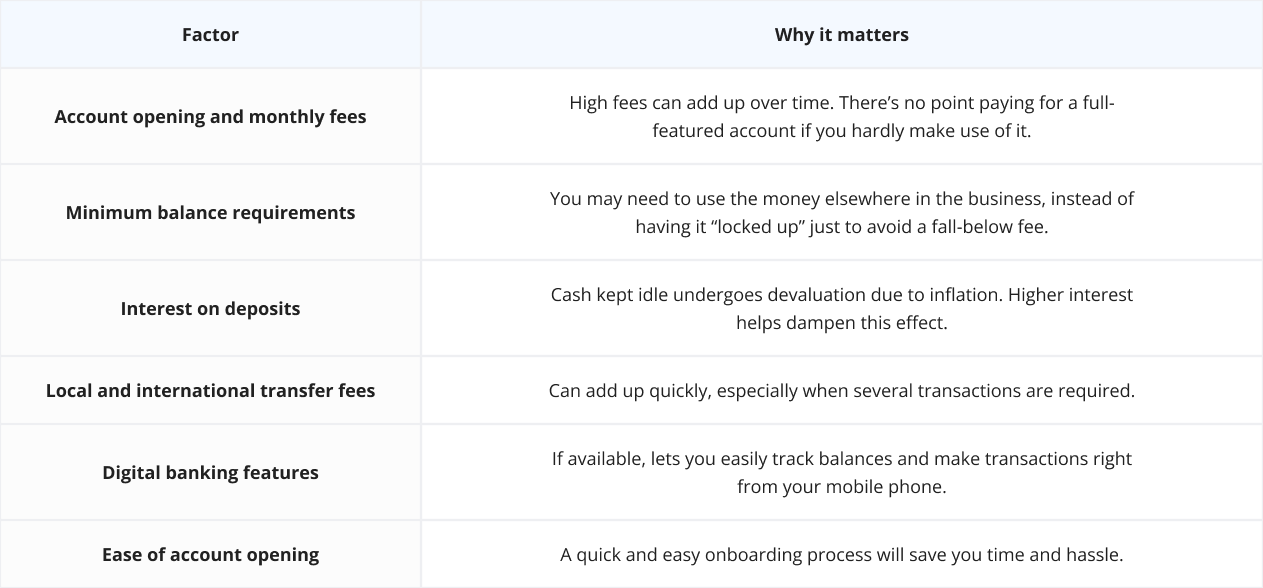
In general, you should determine what type of transactions your business needs to make – this will tell you the features and services you need in your business bank account.
Once you have an idea of what you need from your business bank account, the next step is to evaluate potential candidates by comparing their common features.
Fees and charges
Business bank accounts commonly come with fees and charges, with traditional banks having among the longest list of such. Before you accept these as necessary, know that there are alternative providers that charge lower fees, saving your business unnecessary costs.
Minimum balance and fall-below fees
Business accounts with a minimum balance requirement require you to maintain a certain amount of funds in your account balance. If the balance falls below, you will be charged a fall-below fee. This creates a “lock-in” that hinders you from using your business cash as freely as you may need.
Interest on deposits
Another key factor to consider is the interest paid on funds deposited. This is important because business funds are typically large sums, going up to tens or hundreds of thousands. Leaving such a large sum idle in a low-interest-paying account is detrimental – not only are you losing out on potentially higher returns elsewhere, your cash is being eroded via inflation. Going for a business bank account with a higher interest will be helpful in offsetting these drawbacks.
Local and international transfer fees
If your business needs to make fund transfers frequently, check to see if there are fees for doing so. Local and international transfer fees can quickly add up, bumping up your business expenses and eating into profitability.
There are often multiple components to transfer fees:
- foreign exchange (FX) fees
- FX spread or markup
- agent bank charges
To cut down on unnecessary costs, choose a business account that offers concessions such as zero FX fees for cross-border transfers, and competitive FX spreads. The latter is important; even fee-waived transfers can wind up costing more if a high FX spread is applied.
Digital tools and onboarding
Today, there’s no need to visit a bank branch office and sign physical forms to get a business bank account. Look out for modern fintech bank accounts that offer paperless onboarding; these digital banks also come with robust tools that let you track your account and make transactions on the fly.
Another factor to consider is the digital channels offered by the bank account. For optimal interoperability, make sure your business bank account works with national networks such as FAST and PayNow.
Which business account is right for you?

What should startups look for?
Startups generally need low fixed costs and flexibility in cash flow, and would be best served by a business account with no account opening fees, monthly fees, and no minimum balance requirements. This would enable the company to access and freely use its available business cash, which may see fluctuating levels.
Another beneficial feature would be fast digital onboarding. This would enable a newly registered company to start receiving customer payments or pay suppliers promptly.
What should SMEs look for?
Growing SMEs face increasing transaction volumes and more complex financial administration. This may result in the need for higher transfer limits and multiple authorised account users. As such, it’s a good idea to choose a business bank account that can grow with your business.
Additionally (and this applies to all businesses, not just SMEs), business owners should also keep track of the cost of bank transactions, such as transfers, and fees and charges. If banking charges have risen to a significant degree, it’s worth looking for an alternative, low-fee bank account to keep expenses low.
What should e-commerce businesses look for?
For e-commerce businesses, the focus should be on digital transactions and overseas funds transfers. Because credit card merchant charges are expensive, an e-commerce business can save costs by choosing a business bank account that accepts digital payments such as PayNow and eNETS.
If you purchase from overseas suppliers, you’ll want to watch for foreign transaction fees. Be sure to choose a bank account that offers FX fee waivers, and competitive FX spreads to avoid overpaying.
What should businesses with overseas transactions look for?
Importers, exporters and businesses paying overseas freelancers or suppliers should compare supported currencies, destinations, foreign exchange rates and transfer fees.
If your business deals with several different currencies, it might be worth using a business bank account with multi-currency capabilities. This way, your company can send, hold or receive foreign currencies directly, without paying for currency conversions. This depends on your business’ overseas fund transaction frequency, payment size and how exposed the business is to exchange-rate movements.
Enjoy Low Fees, High Capabilities with Mari Business Account

Mari Business Account is designed to be a low-cost, no-fuss, digital bank account for businesses of all sizes. Whether you’re a startup, SME or e-commerce retailer, you’ll love:
- 0.88% p.a. interest. Earn interest on your business cash, paid daily to your account.
- Zero FX fees. Save on cross-border transactions with zero FX fees and competitive FX rates.
- No local transfer fees. Enjoy free transfers when you pay locally with Mari Business Account.
- Wide coverage. Available across 21 currencies in 59 countries.
- Zero account fees. Keep costs low with Mari Business Account.
- Digital onboarding. No paperwork, no in-person signatures. Apply and get your business account with just your ACRA information.
Ready to lower the cost of your business banking? Apply for Mari Business Account today!