
What is a Balance Transfer & How Does It Manage Debt?
29 May 2026
A balance transfer is an unsecured credit facility used to pay off urgent credit card balances at 0% interest. Used this way, a balance transfer helps you avoid or limit hefty credit card interest charges, making it a suitable option for managing credit card debt.
So how does it work exactly? Essentially, a balance transfer provides the funds to settle up your outstanding credit card balance. You then pay off the balance transfer within a stipulated duration. This effectively transfers your outstanding balance and gives you more time to pay off your debt.
The distinguishing feature of a balance transfer is the interest-free period. During the balance transfer’s tenor – typically between 3 to 12 months – no interest is charged. This feature effectively lowers the interest on credit card debt, compared to rolling over a balance which incurs interest charges every billing cycle.
Balance transfers are flexible; you can use one to pay off several credit cards. Simply apply for an amount large enough to cover your total credit card debt. This will let you consolidate multiple credit card balances into one monthly repayment, instead of having to track separate payments throughout the month.
Another benefit is that balance transfers offer a fixed repayment structure. You only need to pay a minimum sum every month (for example, 3% of your drawdown amount, if you took S$10,000 then you only need to repay S$300), paying the remainder by the final instalment.
While balance transfers come with 0% interest, that doesn’t mean there’s no borrowing cost. Balance transfers come with a one-time processing fee, pegged at a percentage of the amount borrowed. However, this fee is typically much lower than the interest your credit card balance would incur.
Key considerations before choosing a balance transfer
Note that balance transfers are based on your approved credit limit. This is why providers in Singapore commonly require you to apply for a credit card or credit line before processing your request for a balance transfer.
It’s important to take note of any charges and fees associated with the credit card or credit line applied for. For example, in some banks,you may also have to pay annual fees or loan account maintenance fees. In MariBank, for your peace of mind, no annual fee or loan maintenance fee will be charged on any of your credit facilities open with us (accurate as of May 2026).
When choosing a balance transfer, here are some key factors to consider.

Promotional interest rate
Balance transfers in Singapore offer a promotional interest rate of 0%. This applies during the tenor of the balance transfer.
However, once past this interest-free period, any outstanding balance will incur interest charges at the prevailing interest rate. Be sure to choose a right tenor to match your cashflow and pay off your balance transfer in full at the end of the loan tenor, to avoid being charged at higher revolving interest rate afterwards.
Processing/admin fee
Providers may advertise low processing or admin fees on balance transfers, but bear in mind that this is only an indicative quote. The actual processing fee you may get could differ; this is based on several factors including your credit score, amount borrowed, existing loans, and etc.
Your processing fee will be disclosed to you during the application process. Be sure to ascertain the amount, and if you’re comparing between different balance transfers, refer to the EIR for a more accurate gauge of your cost of borrowing.
Repayment period
Commonly, balance transfers are available in repayment periods ranging from 3 months to 12 months, allowing you to choose from various tenors.
Note that different repayment periods may have different processing fees and EIRs, so do take that into consideration. However, as a general rule, it’s best to choose a tenor that allows you sufficient time to fully repay your balance transfer.
MariBank Balance Transfer comes in 3, 6, 9 and 12 month tenors, so you can choose the best fit for your needs.
Minimum payment requirements
Balance transfers may be highly flexible, but you’ll still need to make regular payments each month.
The minimum payment is usually the instalment for that month (for example, 3% of the drawdown amount) plus the one-time processing fee if it is the first month of repayment. When the loan matures, the remaining unpaid amount will be posted to your statement, you will have the choice to repay in full or continue to repay the minimum 3% (at a cost of revolving interest). MariBank Balance Transfer’s minimum monthly payment starts from 3% of the amount borrowed, giving you more convenience in cashflow management.
While you can’t make partial early payments on your monthly instalments, you can absolutely clear your remaining balance in full at any time if you want to become debt-free sooner!
Eligibility
As with all other unsecured credit facilities, balance transfers require applicants to meet eligibility requirements.
Some common eligibility requirements include income level, age, and residency status. Singaporean borrowers also must observe borrowing limits. Your credit score will also impact your eligibility; a low credit score could cause your application to be denied even if you meet all other eligibility criteria on paper.
Balance transfer vs personal loan
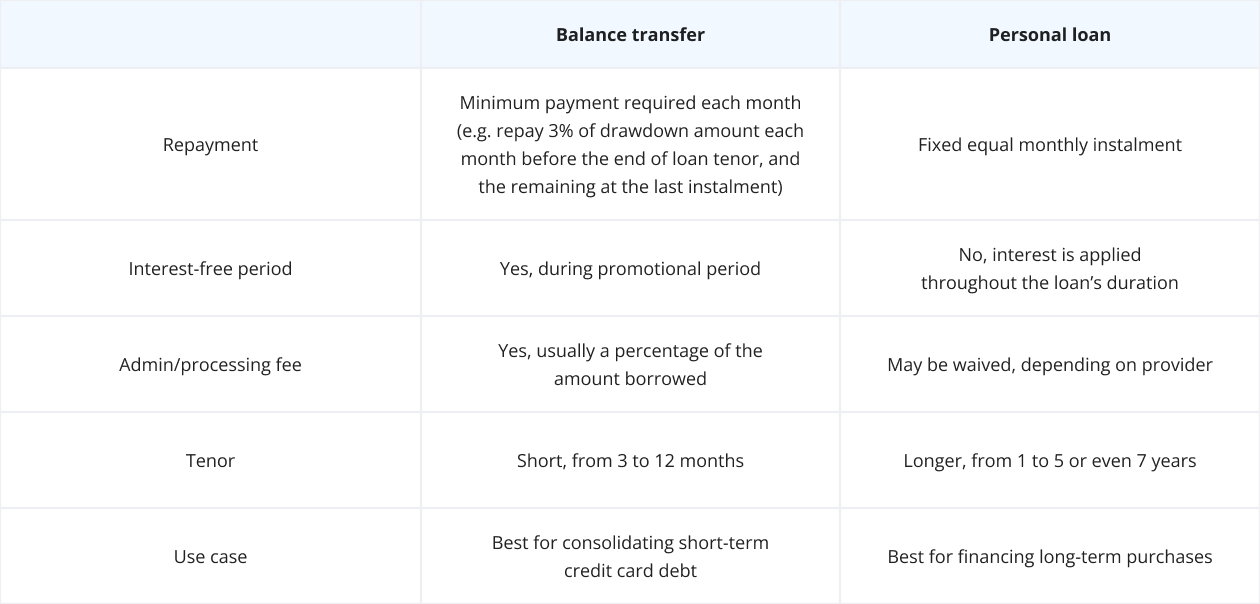
A balance transfer functions similarly to a short-term loan, but there are clear differences between the two. See the table below for a side-by-side comparison.
When should you use a balance transfer?
Now that you understand how a balance transfer works, let’s discuss when you should – and should not – use one.
Balance transfers are highly flexible, but they are limited by a comparatively short tenor of up to 12 months. This means they are better suited for short-term uses, unlike a standard personal loan where its tenor can extend all the way to 60 months.
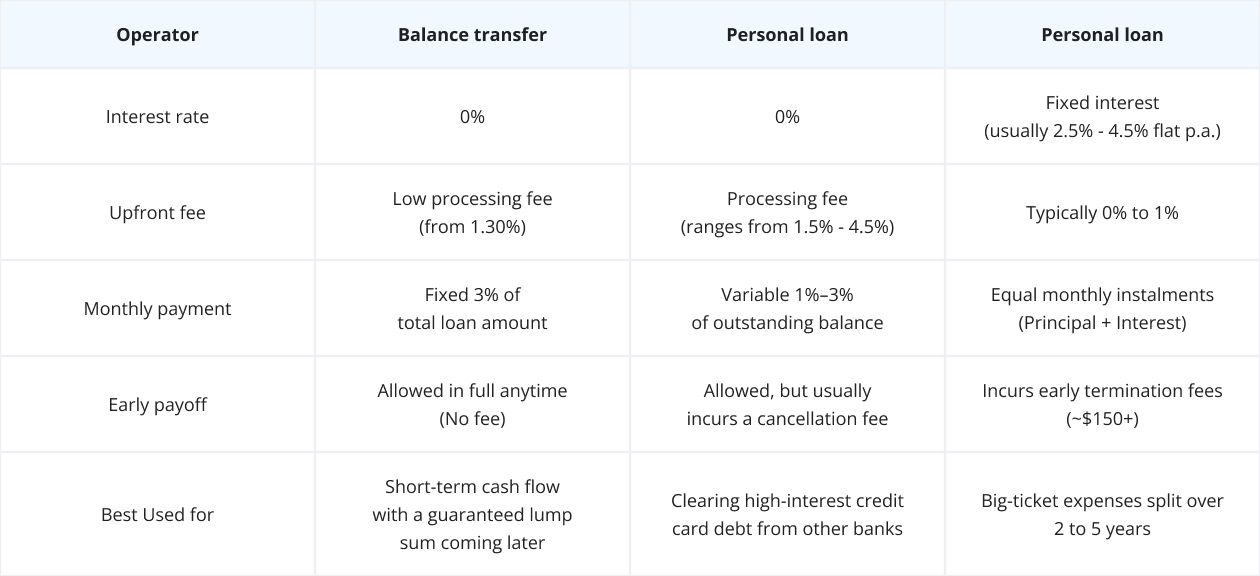
Essentially, balance transfers are designed to help manage credit card debt by providing an interest-free period longer than the conventional 21-day billing cycle. This allows users more time – up to 12 months – to repay their debt without incurring credit card interest charges. Hence, balance transfers are best used if you need more time to pay off your credit card balance in full.
By design, balance transfers also reduce the interest on debt, making them a good option if you’re looking to lower your interest payments (and catch up on paying off your principal debt instead). This effect, however, is temporary, so planning ahead is crucial.
Because a balance transfer only requires the minimum sum to be paid each month, it can be a viable option for managing cashflow needs. You can pay lesser amounts during the balance transfer’s interest-free period, and wait till the final instalment to pay up the balance. Again, planning ahead is essential.
Finally, balance transfers may not be the best option for long-term financing; you’ll be better off with a personal loan for those needs instead. This is because you will have to pay off your balance transfer by the end of the interest-free period – any amount outstanding will be charged interest at the prevailing rate, which may even be higher than the credit card rate with some providers.
Using MariBank Balance Transfer
MariBank Balance Transfer is designed for short-term debt management with a simple and transparent structure. We’ve made it so that not only do you get a competitive EIR, you will also enjoy flexibility and convenience.
How to apply for MariBank Balance Transfer
You will first need to have a Mari Credit Card to apply for Balance Transfer.
Follow these steps if you’re an existing Mari Credit Card holder:
- Log in to your MariBank app.
- Tap on Loans on the home screen.
- Tap on Balance Transfer.
- Tap on Apply.
- Get access to the Balance Transfer feature upon successful application.
Applications will be processed instantly. We will notify you of your application outcome via MariBank app push notification, SMS, and/or email.
Don’t wait to lighten your financial load. Apply for MariBank Balance Transfer and enjoy the freedom to manage your cashflow with more flexibility.
Read More