

Applying for a Personal Loan - All You Need to Know
26 Mar 2026
Whether you’re planning a dream wedding, upgrading your home, or managing unexpected bills, a personal loan is a straightforward way to bridge the gap. It offers a predictable lump sum with a fixed interest rate, meaning you can have a clear idea of how much to repay and how to manage your monthly repayments until the debt is cleared.
While the flexibility of a personal loan makes it a popular tool for smoothing out cash flow, "simple" doesn't mean "automatic." Before you apply, it’s important to understand the fine print.
In this article, we will cover:
- Eligibility: Who qualifies for the best rates?
- The True Cost: Navigating interest rates vs. processing fees.
- Approval Factors: What banks actually look for in your application.
Applying for a personal loan: Key considerations

Advertised interest rate vs effective interest rate (EIR)
When comparing personal loans, one of the most important factors is the Cost of Borrowing. This is made up of the interest charged on loan, as well as other fees and charges that may be included (more on this later). As a general rule, all things being equal, the loan with the lower cost of borrowing will be the better choice.
However, because different lenders have different pricing structures, this can make apples-to-apples comparison impossible in some cases. This is where the effective interest rate (EIR) comes in.
So, what is EIR? Now, when evaluating a personal loan, you’d have noticed that there are two interest rates displayed. For example: 2.5% p.a. (EIR 4.67% p.a.)
The first figure (2.5% p.a.) is the advertised interest rate on the loan. However, this figure does not paint the full picture.
The second figure (EIR 4.67% p.a.) is what you want to pay close attention to. It is a more accurate representation of your cost of borrowing, which, remember, may include fees and charges, depending on the provider of the loan.
With EIR, you can now more accurately compare two loans. Consider the following: Applying
- Loan A: 2.5% p.a. (EIR 4.67% p.a.)
- Loan B: 3.2% p.a. (EIR 4.1% p.a.)
In this case, Loan A has a more attractive advertised interest rate. But it is Loan B that gives you the better deal, as the EIR is lower 4.1% p.a., instead of 4.67% p.a.
Why might this be? One possible reason could be that Loan A also has a sizable processing fee attached, therefore pushing up your total cost of borrowing.
Speaking of…
Processing fees
Personal loans commonly come with processing fees attached. This is a fee charged by the loan provider for processing your loan application, and may come as a fixed amount, or a percentage of the loan amount borrowed.
The processing fee is deducted from your loan before it is disbursed to you. This means that you will receive a lesser amount than what you applied for. This can be a sticking point especially for larger loans, as the processing fee can end up causing your loan to fall short of the amount you need.
As explained above, processing fees (sometimes also known as an admin fee) adds to your cost of borrowing. For this reason, it is best avoided if possible. However, some lenders may choose to fold the processing fee into the interest charged on the loan, so it’s not just simply about choosing a loan with no processing fee.
Once more, refer to the EIR for a more accurate gauge of the cost of borrowing when applying for a personal loan.
Loan tenor
Earlier we explained that personal loans are repaid over a fixed duration. This is known as the loan tenor, during which you will make instalment payments regularly until your loan is fully paid off.
Personal loans come with a range of loan tenors, commonly spanning three to 60 months – with some banks offering up to 84 months. Other providers may offer shorter-term loans six months or shorter.
It’s important to understand that the loan tenor will impact how much you pay per month. For a given loan amount, a personal loan with a shorter tenor will mean higher payments per instalment. However, the benefit is you get to pay off your loan quicker.
Hence, the key is to choose a loan tenor that fits your ability to meet each monthly repayment, while also meeting your preference for how quickly you want to repay your loan. If you choose a loan tenor that is too short, you may be unable to meet the monthly repayments.
Missing your loan repayment will result in a late payment fee and additional interest charges – this may be higher than the interest rate on your loan – on the outstanding amount. There are also other consequences; we’ll discuss this more later.
To avoid this situation, it’s advisable to choose a longer loan duration with lower monthly instalments, this will help ensure you can keep up with your repayments.
Using a loan calculator
You may be wondering how you can determine if a personal loan is affordable for your budget. Don’t fret, you don’t have to bust out the calculator. Most loan providers offer a handy loan calculator that you can use to get a sense of what your monthly repayment may look like.
Just check out the MariBank Instant Loan calculator here .
Available online, you need simply input your loan amount, loan tenor and indicative interest rate. The loan calculator will then display your monthly repayment amount. You can choose different combinations of loan amount and loan tenor to determine the most suitable loan terms for you.
However, do be aware that the interest rate on the loan calculator may not be the interest rate offered to you and you could be offered a higher interest rate. If this happens, your monthly repayments will be higher. As such, it's best to confirm your terms with the loan provider before accepting the loan.
Credit Score and Personal Loan Approval Process

What’s credit score and why does it matter?
Loans come with eligibility requirements (more on this later), but simply meeting them does not guarantee you’ll get your loan. As personal loans are unsecured (there’s no collateral to cover your obligation), lenders need to evaluate your creditworthiness.
This is commonly done by checking your credit score – a personal score maintained by the Credit Bureau of Singapore (CBS) that lenders use to determine how likely you are to repay your loan in full and on time.
Every individual’s personal credit score is calculated based on past behaviours – specifically around how previous financial obligations were handled. For instance, do you pay your bills on time every time, or do you tend to miss payments and pay them late. Do you also have outstanding unsecured debt (unpaid credit card balances, ongoing personal loans etc), and if so, how much.
These (and other) factors are taken into account, impacting your credit score. But if bad habits and missed payments lower your credit score, making an effort to clear your debt and make timely payments will repair your credit score.
You can find out more about credit scores – and purchase a copy of your own credit report – on the CBS website.
Common mistakes that hurt approval chances
Keeping a healthy credit score is important but it is not the only factor that matters. These common mistakes may also hurt your approval chances when applying for a personal loan.
Making too many applications at once
You may think that applying for multiple loans at once will increase your chances of approval. However, it can actually make things worse.
Each time an application for a personal loan (or credit card, for that matter) is made, this triggers a credit check. Too many credit checks in quick succession is read as a sign of financial urgency, which is a negative factor that dampens your creditworthiness.
Instead, be patient and apply for loans one at a time, leaving sufficient time between applications.
Applying for too large a loan
Trying to borrow too much will also hurt your chances of approval. Regulated by the Monetary Authority of Singapore, consumers in Singapore are limited to 12x monthly income in unsecured credit across all borrowings and loans. Applying for a loan that exceeds or even approaches this amount will likely result in a rejection.
Choosing a loan tenor that’s too short
We discussed this earlier but it’s worth repeating here. A shorter loan tenor will mean a high monthly repayment. If the lender determines that the monthly repayment is too high for you to comfortably meet, this will likely cause your loan application to be rejected.
In this case, choosing a longer loan tenor and reducing the monthly repayment could improve your approval chances.
Personal loan eligibility requirements in Singapore
Personal loans have strict eligibility requirements, and failing to meet them will almost always result in a rejection. Eligibility requirements can vary between lenders, but here are some common ones you’ll likely encounter.
• Income level: To qualify for a personal loan, you’ll need an annual income of at least S$30,000 in most cases. Foreigners may need to meet a higher annual income requirement.
• Employment status: In the vast majority of cases, you’ll need to be employed full-time to qualify for a personal loan. Self-employed and commission earners may qualify with additional documents.
• Citizenship/residency: You will need to be a Singapore citizen or have obtained residency in Singapore to be eligible for a personal loan. Foreigners will need to have a valid employment pass to qualify for a personal loan.
• Existing debt obligations: If you have existing debt with the lender, it will impact how much you can borrow. You may be offered a lower personal loan amount, or your application may be rejected altogether.
MariBank Instant Loan – Using your credit card for a personal loan

With MariBank Instant Loan, you can get funds within your credit limit.
Note: that you don’t need to apply for a Mari Credit Card in order to get the Instant Loan, but with the loan approved, it comes with a Mari Credit Card.
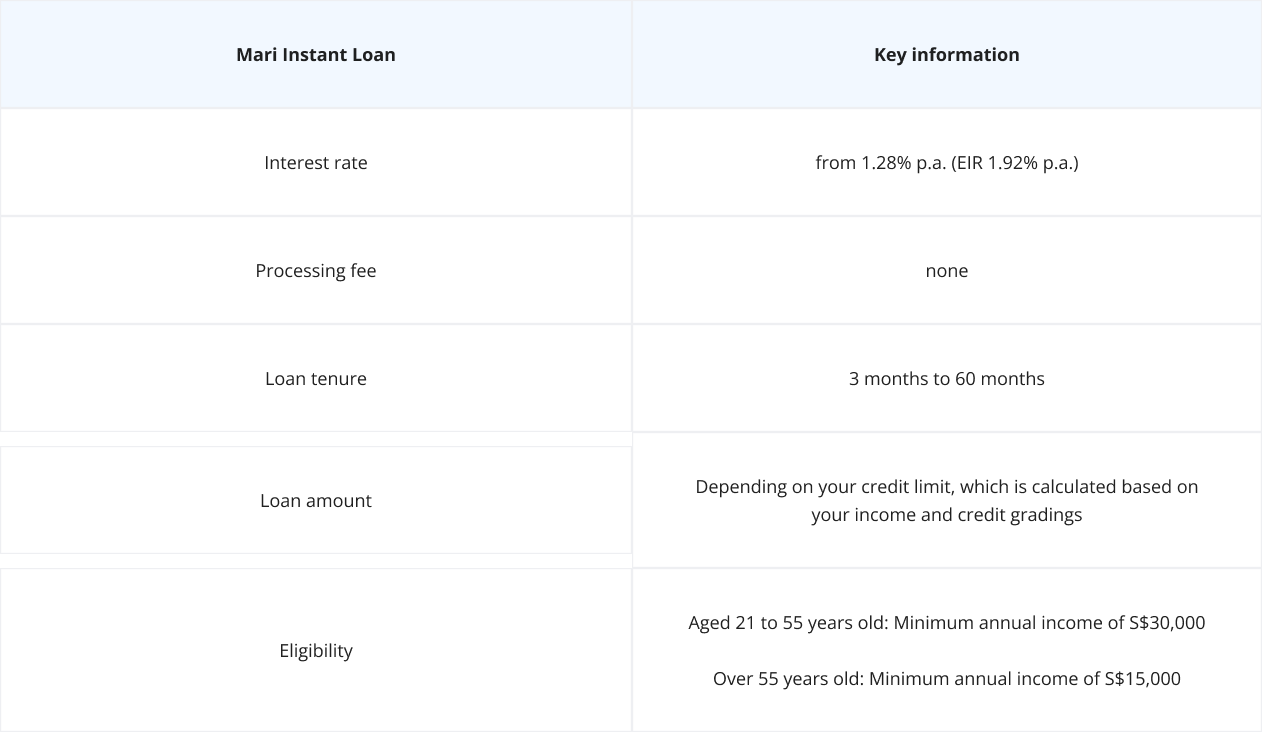
See the following table for essential information regarding Instant Loan.
Why you should choose MariBank Instant Loan
Low interest rate
Borrow from as low as 1.28% p.a. (EIR 1.92%); we’re one of the most competitive personal loans in town.
Instant loan disbursement
Receive your funds within 10 seconds when you apply for the MariBank Instant Loan. Don’t worry, if you don’t have a Mari Credit Card, you’ll be issued one upon approval.
Low minimum loan amount, no processing fee
Unlike other lenders, you won’t have to take out a large loan. Borrow from as little as S$100 to meet your cash needs. Also, there’s no processing fee, which means lower borrowing costs!
Borrow for any reason
From unexpected emergencies to daily cash flow, MariBank Instant Loan is here for when life hands you lemons. Use it however you need, whenever you need it.
Transparent loan management and seamless repayment
Track your loan repayments and make instalments, all on the MariBank app.
Get MariBank Instant Loan
With interest rates starting from 1.28% p.a. (EIR 1.92%), zero processing fees, up to 60 months loan tenor, a low minimum loan amount starting at S$100, and instant approval, the MariBank Instant Loan is the ideal choice for all needs and scenarios.
Have a peace of mind with the low cost of borrowing, outstanding convenience and flexibility, and speedy loan disbursement – right on your MariBank app.
Read More