

What is a Yield Realignment and how does it impact my Payout Per Unit?
1. How is the distribution yield of approximately 6.1%[1] determined for PIMCO GIS Income Fund Admin SGD Hedged - Inc share class (ISIN: IE00B91RQ825) (the “Fund”)?
The PIMCO GIS Income Fund aims to provide investors with a level of income that’s both competitive and sustainable. As such, the Fund determines its distribution level with reference to the portfolio's income-generating potential. It also considers a range of external factors, such as prevailing market conditions, expected investment opportunities, and the global macroeconomic outlook.
Once a distribution level is determined, it is applied uniformly across the Fund’s various share classes. The PIMCO GIS Income Fund offers share classes in multiple currencies. The share class we distribute through Mari Invest Income is a Singapore dollar-hedged share class.
The Fund strives to offer the same distribution yield for all share classes irrespective of currency. That said, share class distribution yields may diverge from their original level over time. This is particularly relevant for currency hedged share classes denominated in currencies with substantial interest rate differentials relative to USD, which is the Fund’s primary currency.
For reference, the July 2026 distribution amount for the above SGD share class was SGD 0.0512 per unit, equivalent to an annualised distribution yield of 6.8%. In comparison, the distribution yield for the Fund’s primary USD share class was 6.1%.
As a result, PIMCO is conducting a routine yield realignment exercise to bring the distribution yields of the Fund's non-USD share classes back to 6.1%[1], aligning the SGD-hedged share class with both the Fund's underlying income generation and its primary USD share class. To find out more on the August 2026 realignment, please refer to Mari Invest - Notice of update to Payout Per Unit for PIMCO GIS Income Fund (25 August 2026).
While the distribution yield of the SGD share class will be adjusted, investors will continue to participate in the same underlying total return stream. Where applicable, a greater portion of returns may now be retained within the share class and reflected through the appreciation of its Net Asset Value (NAV).
2. Why has the distribution yield of the Fund drifted to 6.8% for end July 2026?
Distribution yields are calculated by multiplying the monthly distribution amount by 12 and dividing the product by the Fund’s Net Asset Value (NAV) on ex-dividend day.
For funds with monthly distribution, the annualised distribution yields are annualized on a 12 month calendar year.
Annualized distribution yield = (Dividend Rate * 12) / NAV on ex-dividend day
For illustration:
Annualized distribution yield for end Jul 2026
= 0.0512 x 12 / 9.05 (NAV on July ex-dividend date: 29 Jul 2026)
= 6.8%
Whilst the Admin SGD Hedged share class has been paying a fixed distribution amount of SGD 0.0512 per unit since September 2022, its NAV has trended lower as an effect of hedging from USD into SGD. This has caused the distribution yield to move higher and away from the initial level of approximately 6%.
Please note that a reduction in Net Asset Value does not imply negative performance. Over the past 3 years, the Admin SGD Hedged share class has delivered returns of 3.88% (As of 31 July 2026, after fees, and on the assumption that distributions are reinvested). In comparison, the performance reference benchmark (Bloomberg U.S. Aggregate (SGD Hedged) Index) has delivered an annualised return of 1.40% over the same period.
See below Performance Update for more details on fixed income market returns.
3. What is a Currency Hedged Share Class?
Currency Hedged Share Classes can be a useful tool for mutual fund investors to gain exposure to assets denominated in foreign currencies, without taking on the full accompanying currency risk. They can allow investors to effectively make independent decisions on which assets they want exposure to, and which currencies they want exposure to.
Currency hedged share classes seek to minimize, but cannot completely eliminate, a fund investor’s currency risk. Specifically, they aim to reduce the impact of exchange rate fluctuations between the fund’s base currency and the investor’s preferred currency of exposure.
For more information:
https://www.pimco.com/sg/en/resources/education/understanding-hedged-share-classes
4. What is Currency Hedging Cost?
Currency Hedging Cost is the cost of protecting SGD investors from fluctuations between the USD base currency of PIMCO GIS Income Fund and the SGD denomination of PIMCO GIS Income Fund Admin SGD Hedged - Inc share class.
Currency Hedging Costs are largely driven by the interest rate differential between the two currencies.
For illustration purposes only:
USD 1 month interest rates: 3.7%
SGD 1 month interest rate: 1.1%
Interest rate differential between USD and SGD = 3.7% (USD) – 1.1% (SGD) = 2.6% p.a.
5. If Currency Hedging Cost is largely driven by interest rate differentials, does that mean it will change over time?
Yes, interest rates can fluctuate and change, resulting in interest rate differentials increasing or decreasing over time.
PIMCO’s base case view is for no change in US Federal Reserve rates for 2026, and potentially 1 to 2 cuts in 2027.
This may potentially lead to lower Currency Hedging Costs between USD and SGD over time.
6. Does Currency Hedging Cost only impact the PIMCO GIS Income Fund Admin SGD Hedged - Inc share class?
No, Currency Hedging Costs impacts all currency hedged share classes of any mutual funds/unit trusts where the base currency is different from the hedged currency.
As shared above, Currency Hedging Cost is largely a reflection of market interest rate differentials.
7. What is the current Currency Hedging Cost between USD and SGD?
As of 31 July 2026, Currency Hedging Cost between USD and SGD was approximately 2.4% to 2.6% p.a., based on the interest rate differential between 1 month USD and SGD interest rates
8. How does Currency Hedging Cost affect returns?
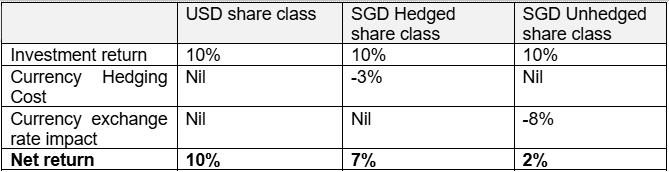
For illustration purposes only:
Assumptions
- A USD base currency fund delivers returns of 10%
- Currency hedging cost between USD and SGD is 3%
- USD weakens 8% against SGD
In summary,
- An SGD denominated investor in the SGD Hedged share class gives up some returns after paying the Currency Hedging Costs, but has lower currency exchange rate risk.
- An SGD denominated investor in the SGD Unhedged share class will be exposed to greater currency rate risk.
9. How is my monthly payout calculated?
Your monthly payout depends on the fixed distribution amount (Dividend Per Unit) paid by the Fund and the Number of Units you hold.
For illustration purposes only:
You own 100,000 Units of the Fund
The fixed distribution amount (Dividend Per Unit) is SGD 0.0462
Your Monthly Payout = Units you hold x Dividend Per Unit
= 100,000 Units x SGD 0.0462
= SGD 4,620
10. How often will PIMCO change the fixed distribution amount of the Fund?
Going forward, the distribution amount of the Fund’s SGD Hedged share class will be realigned semi-annually each August and February to minimize drift from the distribution yield of the Fund’s primary USD share class, which is approximately 6.1%[1].
Please note that the distribution yield for the overall Fund is reviewed on an ongoing basis and may be increased or decreased outside of the above semi-annual schedule.
11. Do I need to do anything?
No action is required from you. Your monthly payouts will automatically reflect the updated rate and continue to be deposited into your designated account as usual.
How to track your payouts in the MariBank app: Although no action is needed, you can easily monitor your updated payout details anytime:
- Open the MariBank app and go to Mari Invest > Mari Invest Income.
- Tap My Holdings to view your updated estimated payout amount.
- Check Transactions after each monthly payout date to view the full breakdown, including the confirmed Payout Per Unit (DPU) applied.
12. What does this mean for the Fund’s overall performance?
The Fund remains competitive, well-managed, and on track. A yield realignment is a routine administrative process ensuring the Fund’s distribution yields remain consistent across its various share classes. It does not reflect a change in the Fund’s risk profile, credit quality, or underlying investment strategy.
Want to learn more about performance?
For PIMCO’s latest commentary read here:
PIMCO Income Fund Performance Update
Market Overview (as of 20 August 2026)
After easing in June, tensions between the United States and Iran resurfaced, sparking concerns over potential energy supply disruptions and renewed instability across the Middle East. Brent crude surged +20.40% over the month of July, reversing much of June's decline and recording its strongest monthly gain in more than a year.
Higher energy prices briefly reignited inflation concerns. Although most developed market central banks left policy rates unchanged during July, investors increasingly questioned how quickly interest rates could be reduced if inflationary pressures proved more persistent than anticipated. As a result, bond yields rose across most major markets.
Despite these moves, core inflation in the US (which excludes volatile energy prices) continued to moderate in line with market expectations.

As of 20 Aug 2026. Source: Bloomberg.
Past performance is not a guarantee or reliable indicator of future results.
PIMCO GIS Income Fund Performance Update (as of 20 August 2026)
Bond prices move in the opposite direction of interest rates, meaning that as interest rates rise, bond prices typically fall, which creates short-term pressure on the Fund’s unit price.
Performance for the PIMCO GIS Income Fund saw moderate pullback in July as interest rates rose and recovered in the first few weeks of August as they retraced downwards.
PIMCO’s view is that the US-Iran conflict is likely to remain contained and should not lead to a prolonged rise in inflation. Central bank interest rates are already set at elevated levels, which helps keep inflation pressures contained.
What lies ahead for PIMCO GIS Income Fund?
The Fund currently benefits from a historically high level of starting yields in high quality global fixed income markets, with portfolio Yield-to-Maturity[2] now above 7%. In recent decades, starting yields have been a reliable forward-looking return indicator, and have generally provided useful context when assessing long-term investment outcomes. High starting yields can provide a cushion by providing investors a stream of income that can potentially offset headwinds from interest rate movements or market volatility.
While not immune to short-term volatility, the Fund has a proven track record of generating competitive returns while navigating challenging market environments for over 13 years.
The Fund maintains a high-quality AA-rated[3] portfolio which is diversified globally, across different fixed income sectors. This high-quality focus means that the Fund can potentially maintain its resilience if economic weakness starts to materialise.
Well-positioned for different scenarios
If the US–Iran conflict de-escalates, markets could see a relief rally, with both equities and bonds benefiting. In this scenario, bond yields will likely fall, which would support bond prices and potentially enhance the Fund’s capital gains.
Conversely, if the conflict intensifies or becomes prolonged, the bigger risk shifts toward slower economic growth. In such an environment, central banks may eventually need to ease policy to support the economy, which would also be supportive for the portfolio.
Importantly, the Fund remains flexible, allowing it to take advantage of opportunities as market conditions improve.
Based on information provided by PIMCO, as of 20 August 2026.
[1] The Fund’s actual distribution rate may be higher or lower. See additional disclosures below. Based on annualized monthly distribution yield for the Admin SGD-H Income share class. The annualized monthly distribution yields are annualized on a 12 month calendar year [Annualized monthly distribution yield= (Dividend Rate * 12) / NAV on ex-dividend day].
This share class aims to pay dividend on a monthly basis. Dividend is not guaranteed.
Past distributions are not necessarily indicative of future trends, which may be lower. A positive distribution yield does not imply a positive return. Distribution payments of the Fund where applicable, may at the sole discretion of the Fund, be made out of either income and/ or capital of the Fund. In the case of the Fund, the Fund may at its discretion pay dividends out of capital which may result in an immediate reduction of the Fund’s NAV per share.
[2] PIMCO calculates a fund's Estimated Yield to Maturity by averaging the yield to maturity of each security held in the Fund on a market weighted basis. PIMCO sources each security's yield to maturity from PIMCO's Portfolio Analytics database. When not available in PIMCO's Portfolio Analytics database, PIMCO sources the security's yield to maturity from Bloomberg. When not available in either database, PIMCO will assign a yield to maturity for that security from a PIMCO matrix based on prior data. The source data used in such circumstances is a static metric and PIMCO makes no representation as to the accuracy of the data for the purposes of calculating the Estimated Yield to Maturity. The Estimated Yield to Maturity is provided for illustrative purposes only and should not be relied upon as a primary basis for an investment decision and should not be interpreted as a guarantee or prediction of future performance of the Fund or the likely returns of any investment.
[3] Average Credit Quality (ACQ) is calculated by PIMCO using an internal proprietary calculation methodology and ranges from AAA (highest) to D (lowest); the portfolio contained herein is not reflective of individual ratings by an independent rating agency. ACQ is a market-weighted average of the credit ratings of the credit instruments and holdings which create bilateral counterparty risk, excluding equities and certain other instruments. In calculating the ACQ of a portfolio, PIMCO generally uses the highest of the ratings of S&P, Moody’s or Fitch assigned to each issuer held by the portfolio. If an issue or issuer is unrated, it is generally assigned a rating by PIMCO. A significant portion of a portfolio’s ACQ may be derived from ratings assigned by PIMCO. ACQ is calculated on a daily basis for each portfolio and will change over time as the ratings for individual securities held in the portfolio change or as instruments are added and removed from the portfolio. In general, instruments are weighted at their market value. Certain derivatives, such as credit default swaps, are weighted at “bond equivalent value,” which is the notional amount of the instrument adjusted by the current gain or loss on the position. Certain unrated instruments are not assigned a rating by PIMCO (such as OTC Credit Spreads, Money Market futures, Equity futures, and common stock) and are excluded from the ACQ calculation. This could lead to an under- estimation and under-statement of the credit risk of a portfolio. The portfolio itself has not been individually rated by an independent rating agency. The credit quality of a particular security or group of securities does not ensure the quality, stability or safety of the entire portfolio. PIMCO-assigned ratings used in the calculation may not be representative of PIMCO’s current views should the security review have occurred on a date other than the date that this calculation was generated, which will generally be the case, or should an event that could affect a credit rating have occurred.
Bloomberg U.S. Aggregate (SGD Hedged) Index represents securities that are SEC-registered, taxable, and dollar denominated. The index covers the U.S. investment grade fixed rate bond market, with index components for government and corporate securities, mortgage pass-through securities, and asset-backed securities. These major sectors are subdivided into more specific indices that are calculated and reported on a regular basis. It is not possible to invest directly in an unmanaged index. Unless otherwise stated in the prospectus, the Fund is not managed against a particular benchmark or index, and any reference to a particular benchmark or index in this factsheet is made solely for risk or performance comparison purposes.
Past performance is not a guarantee or a reliable indicator of future results. This advertisement or publication has not been reviewed by the Monetary Authority of Singapore.
Additional information: This material may contain additional information, not explicit in the prospectus, on how the Fund or strategy is currently managed. Such information is current as at the date of the presentation and may be subject to change without notice.
PIMCO Funds: Global Investors Series Plc is an open-ended investment company with variable capital and with segregated liability between Funds incorporated on 10 December, 1997 and is authorised in Ireland by the Central Bank as an undertaking for collective investment in transferable securities pursuant to the European Communities (Undertakings for Collective Investment in Transferable Securities) Regulations, 2011 (S.I. No. 352 of 2011) as amended. The information is not for use within any country or with respect to any person(s) where such use could constitute a violation of the applicable law. The information contained in this communication is intended to supplement information contained in the prospectus for this Fund and must be read in conjunction therewith. Investors should consider the investment objectives, risks, charges and expenses of these Funds carefully before investing. This and other information is contained in the Funds prospectus. Please read the prospectus carefully before you invest or send money. Past performance is not a guarantee or a reliable indicator of future results and no guarantee is being made that similar returns will be achieved in the future. Returns are net of fees and other expenses and include reinvestment of dividends. The performance data represents past performance and investment return and principal value will fluctuate so that shares in the sub-funds of PIMCO Global Investor Series, when redeemed, may be worth more or less than the original cost. Potential differences in performance figures are due to rounding. The sub-funds may invest in non-U.S. or non-Eurozone securities which involves potentially higher risks including non-U.S. or non-Euro currency fluctuations and political or economic uncertainty. For informational purposes only. Please note that not all Funds are registered for sale in every jurisdiction. Please contact PIMCO for more information. For additional information and/or a copy of the Funds prospectus, please contact the Administrator: State Street Fund Services (Ireland) Limited, Telephone +353-1-776-0142, Fax +353-1-562-5517. ©2026
Risk: Investing in the bond market is subject to risks, including market, interest rate, issuer, credit, inflation risk, and liquidity risk. The value of most bonds and bond strategies are impacted by changes in interest rates. Bonds and bond strategies with longer durations tend to be more sensitive and volatile than those with shorter durations; bond prices generally fall as interest rates rise, and low interest rate environments increase this risk. Reductions in bond counterparty capacity may contribute to decreased market liquidity and increased price volatility. Bond investments may be worth more or less than the original cost when redeemed. Investing in foreign denominated and/or domiciled securities may involve heightened risk due to currency fluctuations, and economic and political risks, which may be enhanced in emerging markets. Currency rates may fluctuate significantly over short periods of time and may reduce the returns of a portfolio. High-yield, lower-rated, securities involve greater risk than higher-rated securities; portfolios that invest in them may be subject to greater levels of credit and liquidity risk than portfolios that do not. Sovereign securities are generally backed by the issuing government, obligations of U.S. Government agencies and authorities are supported by varying degrees but are generally not backed by the full faith of the U.S. Government; portfolios that invest in such securities are not guaranteed and will fluctuate in value. Mortgage and asset-backed securities may be sensitive to changes in interest rates, subject to early repayment risk, and while generally supported by a government, government-agency or private guarantor there is no assurance that the guarantor will meet its obligations. Entering into short sales includes the potential for loss of more money than the actual cost of the investment, and the risk that the third party to the short sale may fail to honor its contract terms, causing a loss to the portfolio. Derivatives may involve certain costs and risks such as liquidity, interest rate, market, credit, management and the risk that a position could not be closed when most advantageous. Investing in derivatives could lose more than the amount invested. Diversification does not ensure against loss.
This material contains the current opinions of the manager and such opinions are subject to change without notice. This material has been distributed for informational purposes only and should not be considered as investment advice or a recommendation of any particular security, strategy or investment product. Information contained herein has been obtained from sources believed to be reliable, but not guaranteed. No part of this material may be reproduced in any form, or referred to in any other publication, without express written permission. PIMCO is a trademark or registered trademark of Allianz Asset Management of America LLC in the United States and throughout the world. ©2026, PIMCO.
PIMCO Asia Pte Ltd (8 Marina View, #30-01, Asia Square Tower 1, Singapore 018960, (65) 6491-8000, Registration No. 199804652K) is regulated by the Monetary Authority of Singapore as a holder of a capital markets services licence and an exempt financial adviser. The asset management services and investment products are not available to persons where provision of such services and products is unauthorised.
Contact Us
Our 24/7 Customer Service Team is here for you if you have any questions!